
Can a Transformation Coach Help With Confidence Issues?
Yes. If I can do it so can you. I went from playing it small, drowning in my life to a calm, confident, and empowered husband, father, and entrepreneur. A transformation coach can help you with confidence issues, but not by handing you a few affirmations and telling you to stand taller in the mirror.
That might help a little. It probably will not touch the real issue.
For a lot of capable people, confidence is not missing because they lack skill, intelligence, ambition, or potential. Confidence is missing because they are measuring themselves through the wrong lens. They are comparing themselves to everyone ahead of them. They are judging themselves against an imagined version of who they should already be. They are trying to win approval from people whose standards keep changing. They are looking at the mountain and forgetting they already climbed five others.
Confidence is not about convincing yourself you are impressive. It’s about…
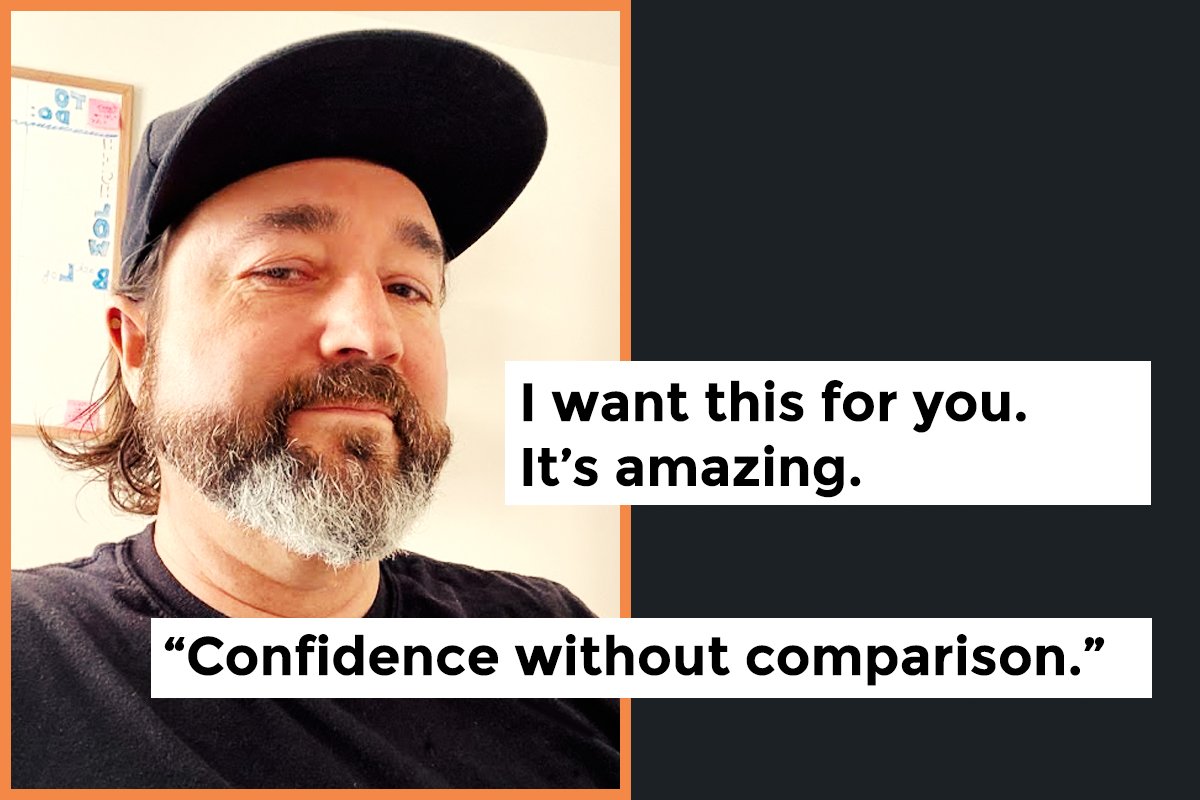
🔸“Confidence without comparison.”🔸
That is the deeper work.
Confidence Issues Are Usually Not About Capability
Most people who come to this kind of work are not helpless. They are often highly capable. They may be successful at work. They may be the person everyone else relies on. They may have built a good life on paper.
And still, inside, they feel strangely uncertain. If this is you…know that you’re not alone. Living in confidence and standing out isn’t given. It’s earned. And it takes some work. But it is very doable. You deserve it.
These people, maybe you, second-guess themselves. They overthink constantly about what other people will think of them, the way they do their work, and their outcomes. They may not even see this behavior because they’ve lived it for so long. (That was me for 40+ years despite my successes!) They struggle to speak clearly when it matters. They hold back in relationships. They avoid leadership moments they are absolutely capable of handling. That’s the frustrating part. You can be competent and still not feel confident. You can have proof everywhere and still not believe it. You can be the person other people admire while privately thinking, “I don’t know what I am doing.” This can feel like surviving. Which sucks.
All of this is usually not an issue of one’s capablity, but one’s perspective, skewed as it is. It’s often a fear issue. On a deeper level it’s an identity issue of how you’ve come to see yourself. Often imposed by others. You are not seeing yourself accurately. You are seeing yourself through comparison, old judgment, and other people’s beliefs, judgments, and reactions. Which is fair, to be clear. The external world is often the testing ground to edify how we want to be and how we see ourselves. However it’s a very random and chaotic way of going about it. It’s how we learn to operate as children.
As strong, grounded, integrated, and confident adults….we need to learn another way. You just haven’t learned it yet. Neat!
Constant Comparison Makes Confidence Impossible
One of the clearest phrases I ever learned from a mentor was this: “Confidence without comparison.”
I still remember sitting in the kitchen during that zoom call, because it struck me so deeply. It’s a complete reframe of how I had defined myself. “Good job - Bad Job - Great Job!” All out the door. Whoah!
To be clear, we have to first pick a target, a goal, in which we desire to strive towards. We do that based on who we are, what we have, and what we want. That does require an initial bit of comparison to something we are not or do not have. Great starting point but not something that drives the motivation of achievement.
What most people do that keeps them stuck is constantly comparing themselves to people ahead of where they are at. They look at where someone else is and turn it into proof that they are behind… the entire time they are working towards the goal.
That might feel like motivation. but it slowly becomes demoralizing punishment of oneself. “I’m not enough.” slowly grows. Screw that!
In that process you stop seeing what you have already done in your progression. You stop seeing what you have survived. You stop seeing the skills you built so slowly that they now feel obvious. You forget that the thing that feels easy now was once difficult.
You see yourself through the lens of your judgments of someone else. That’s like focusing on yourself with an extra, very unnecessary step.
This all matters because confidence is not built by staring at the gap between you and someone else. Confidence is built by staring at where you were and where you are today..The progress you are making.
On a more holistic level, what did struggle with that now feels normal? What hard things did you learn? Where did you keep going when you did not know how? Where are you already more capable than you were a year ago?
That’s not being egotistical. That’s seeing yourself honestly.
If that brings up some discomfort, then look at this as an issue of balance between extremes. On one end you have “I suck,” and on the other, “I’m amazing.” If you live in extremes your rhetoric and the accompanying feelings will tend to be on the extreme ends. What I see often with people is the more extreme the lack of confidence the more uncomfortable it feels to counter it by seeing your worth. “That just sounds like I’m full of myself.” Is a statement I’ve heard many times from clients. That’s a learned statement. You can unlearn that.
You are not where you want to be. Fine. You are also not where you started.
Both are true. Confidence begins when you stop using the first truth to erase the second.
People’s judgments are a game you can’t win
A lot of confidence issues come down to one fear: what will people think of me?
That fear makes sense in childhood. As children, we have to care what the people around us think and feel about us. Our safety depends on it. Our nervous system learns very early that approval matters. But as an adult, that old survival strategy can become a prison keeping you from the excellence you’re after.
So you start performing instead of living. You start managing your reactions instead of telling the truth. You start trying to be “good enough” for people who have not even clearly told you what “good enough” means.
And this is some tragic bullshit we are not taught. Other people’s judgments are unstable.
One person’s “great job” is another person’s “mediocre.” One boss values speed. Another values polish. One partner sees emotional expression as intimacy. Another sees it as too much. One person admires your directness. Another feels threatened by it. Their judgment of you is not based only on you. It is based on their history, their expectations, their wounds, their preferences, their values, and overall life experience.
When you rely only on other’s judgments of you, you hand the reigns to other’s fickle opinions.
There is one exception: clear agreements.
At work, performance matters. Expectations matter. If someone is paying you to do a job, you need to know what success looks like. You need clear communication. “What does good look like here?” and “How will we measure success?”
That’s different. Not approval-seeking. That is reality-based performance.
But trying to be liked, approved of, admired, and feeling safe based on the whims of others is a folly highly successful people drop. It’s a waste of energy, time, and money. And you only have so much of those.
Why Basic Confidence Advice Often Fails
A lot of confidence advice works on top of who you are. Affirmations like “Fake it till you make it. “ or “Think positive” are simply statements without depth. They don’t drill down to the suboncious level of how you see yourself.
If you see yourself as self-conscious, awkward, too emotional, too intense, not enough, too much, or secretly incapable, then “I am confident” may feel like nonsense. Your subconscious behaviors will keep acting from that old, self-imposed, identity.
This is where Transformation coaching works differently. We don’t start by pretending the old identity is gone. We start by emotionally connecting with it.
“I don’t trust myself when people criticize me.”
“I’m too emotional.”
“I’m awkward.”
Getting to these statements is key because they acknowledge how you see and feel about yourself. Stepping into that emotional space edifies the decision to change those beliefs.
If you don’t know the identity runnins the show then you can’t actually address it and change it.
Transformation Coaching is About WHO You Believe Yourself to Be
Identity-level coaching asks a different question. Not just, “What should you do?” But, “Who do you believe you are in these moments you struggle with?”
Your behaviors, the words, feelings, and actions you inhabit are outward expressions of WHO you believe you are. It’s crazy when you begin to notice how obvious it is. I used to say to my wife, “Let me go to the bathroom first.” Not, “I’m going to the bathroom first.” I’m actually asking for permissions still, as a grown man…. “Let me.” Sheesh.
If you believe you are a messy person, you will actually have a messy living space. It’s almost like you’re performing the identity. Isn’t it?
There’s nothing wrong with you here. You just haven’t learned to see yourself more closely and honestly, and believe you can be different. Who you want to be.
Who do you want to be? It is that simple. From there you simply work at it.
You identify the old identity or belief. You move through the discomfort of accepting it. Then you step back into the world, noticing where it shows up. Then you practice from a new identity in those same moments.
“I am a confident person.” In real-world action this becomes, “What would a confident person do in this moment?” And you keep practicing that. Simple. Lengthy and a bit hard but very doable.
The point is not to magically believe it forever the first time you say it. The point is to interrupt the old behaviors.
A Client Example: From Shame to Self-Worth
One client I worked with carried a lot of shame around being emotional. A parent had judged them for showing emotion, and over time the client had taken on low self-worth, simply for being “too emotional.” That internal identity drove that shame.
In session, we discussed this on a deeper level. It was less about “being shamed” and more about “allowing someone to shame me.” Huge difference. They realized, “I don’t have the self-worth or confidence to push back.”
That was not a small moment.
From there, we worked both sides. First, we looked at their actual capability and strength. This person was emotional, yes. But being emotional also meant they could bring warmth, tenderness, and depth into relationships. For them, it was a matter of place and time to be emotional vs “being too emotional” itself.
Crying all the time at work may not serve you. Feeling deeply while watching a sunset, talking to your partner, or being present with your family can be a beautiful strength.
Same trait. Different context. Different expression.
Second, we looked at the parent’s perspective. It became clear this parent had their own shame around showing emotions, to the point of becoming volatile when others did it. Contradictory at it’s most crazy making. Seeing that the client could not create or redefine this perspective themselves they learned to let go of that wasted energy trying to “make” the parent change their behavior.
A couple of weeks later, the client came back explaining how they pushed back against their parent, without anger, but with enough energy to create a boundary, “Can you just let me have my emotions? I understand you’re upset about it. I’m still going to have my emotions over here.”
The parent did not respond beautifully. My client however learned they could hold a boundary, be themselves, and feel confident in what was previously seen as a shameful weakenss. AWESOME.
When they told me the story, their whole manner was different. Their voice was different. Their posture was different. They embodied a different way of being. (Always feels magical when that happens.)
They were telling me who they were without words. I pointed it out, and they lit up. They sat taller. We let the moment sit there for a second. Big smiles all around.
That is confidence becoming real. Not as an idea. As a lived shift in identity come forth in their behaviors, tone, words, and smiles.
The Method: How Confidence Gets Rebuilt
When I help someone re-discover their confidence I’m looking for a pattern of where it shows up and where it does not.
Confidence is rarely missing everywhere. You may lack confidence in dating but not at work. You may lead teams easily but freeze when your partner is upset. (I know that one well!) You may speak clearly with friends but collapse when someone with authority criticizes you.
That means the question isn’t, “Why am I not confident?” The better question is, “Where and when am I not behaving confidently?”
Habits are predicated by cues. A moment, event, time of day, feeling, person, etc.
By finding these moments we begin to see that confidence is not a mysterious personality trait some people have and others do not. It’s contextual. So we look at the fact you can act confidently as proof of your ability to do so. With that in tow we re-approach the moments that you feel you lack confidence, as a confident person. It’s simple but takes practice. Habits form as quick as you use them.
Psychologist Albert Bandura’s work on self-efficacy is useful here. Self-efficacy is your belief in your ability to influence your motivation, behavior, and performance. One of the strongest sources of self-efficacy is mastery experience: seeing that you have succeeded, learned, or improved before. In plain English, your brain needs evidence. Not fluff. Evidence.
Source: American Psychological Association, Self-Efficacy and Human Agency
That is why we use your history. Not to inflate you. To remind you what is true.
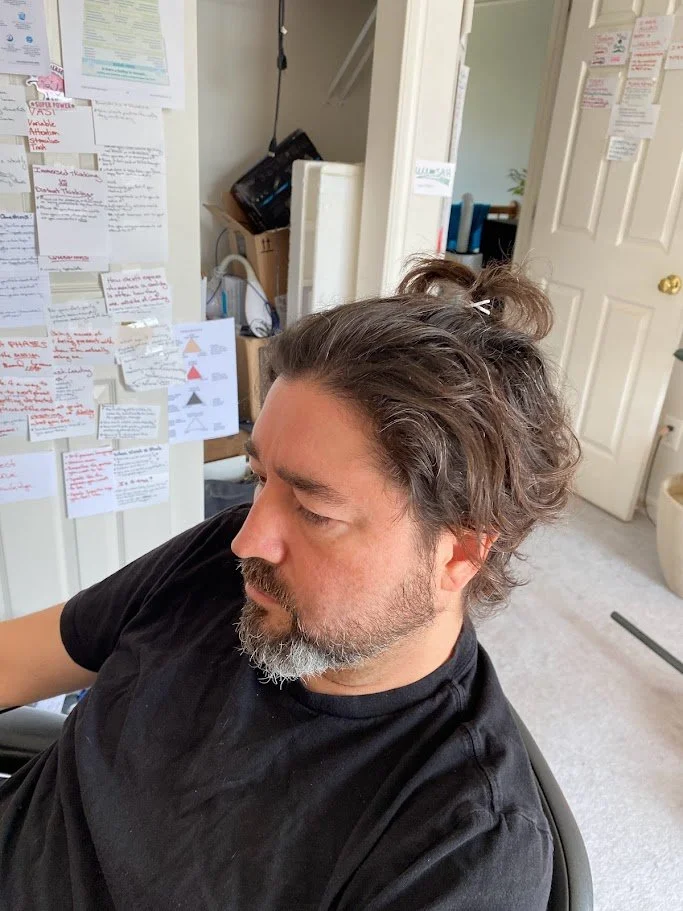
When I was rebuilding my identity I had notes on every wall of my office. Reminders I “ingested” of new ways of thinking and feeling. (Interrupted by my daughter tying small ponytails in my hair. 💖)
The Reminder Is Part of the Work
One of the funnier parts of this work is that you have to remember to practice the new identity.
Your thoughts and feelings are practiced patterns of behavior living in a “low ram” area of your brain. This is why you need to have reminders of how to think, feel, and behave, to break these old patterns.
“I am a confident person.” You can put this on your phone, an alarm, or even write it up your arm, boldly, in marker. That may feel silly. But isn’t that a great expression of building confidence? Being willing to stand up to the judgments of others for writing on yourself?
If you are afraid to write “I am a confident person” on your hand because someone might see it and think it is dumb, then congratulations. You found the exact fear running the pattern.
What would a confident person do if someone noticed? Probably something like: “I’m working on my confidence because I want to become the person I know I can be.”
That’s hard to argue with.
When Transformation Coaching Is the Right Fit
This level of work is for those who are sick of horizontal tactics that never stick. You've consumed the books and hired the basic coaches, yet your old "pre-therapy" rules still run the show. Which is exhausting and demoralizing.
Identity or transformation coaching is for those stable enough for honest introspection and ready to practice real change in the arena. It’s for high-achievers tired of hiding in people-pleasing, overthinking, and performing for everyone else’s expectations.
This is where the therapy distinction becomes vital. If you’re drowning in trauma or emotional flooding, therapy comes first. That’s not a failure it’s being smart about the approach. Coaching kicks in when you’re ready to stop analyzing the wound and start building the new person who can live the life you want.
Is Identity Transformation Coaching Good for People on the Spectrum?
This work is especially powerful for brilliant neurodivergent people who have spent a lifetime masking their intensity and trying to "play normal" while still pushing for greatness.
Most of my clients are unusually intelligent, perceptive, and systemic thinkers. That capacity for greatness is exhausting when it’s filtered through shame. But once you learn to manage that brain and heart, it becomes a kick-ass tool set.
Can coaching help me if my brain works differently? - Of course! But it takes the right coach for you…
Confidence Is Built by Becoming Who you Are and Striving for Who you Wish to Be
Confidence isn’t some arrogant performance or pretending to be the smartest person in the room.
Real confidence is the radical belief that you can handle the moment, figure it out on the fly, or pick yourself up if you fall flat on your face. It’s also knowing people will judge, misunderstand, or talk beyond your back, and that doesn’t have to uproot you from who you are.
Stop living by comparison. Stop outsourcing your value to others. Stop waiting for permission. Honestly, relax a bit. Then move. All that tension and stress usually comes from fear, not you being your excellent self.
You first audit yourself honestly. The uncomfortable and the comfortable. The brilliance, the bullshit, the patterns, and the potential. Then you start building the changes you desire.
From the TRUTH.
The right coach helps you spot the pattern quickly, name the identity driving it, and practice a new way of BEING until confidence isn’t a story you’re telling yourself.
It becomes your baseline. How you show up in the arena when the pressure is on.
You don’t need a new personality. You need to stop measuring your soul against everyone else’s achievements and judgments.
Confidence without comparison.
That’s where the adventure begins. I want to see you step into this. To succeed and change and live life more fully. You get to do this once. You’re not behind. You’re right where you need to be….ready to take that next step.

🔸Jump into a free call to map the patterns you’re stuck in and find what moves you forward.🔸